

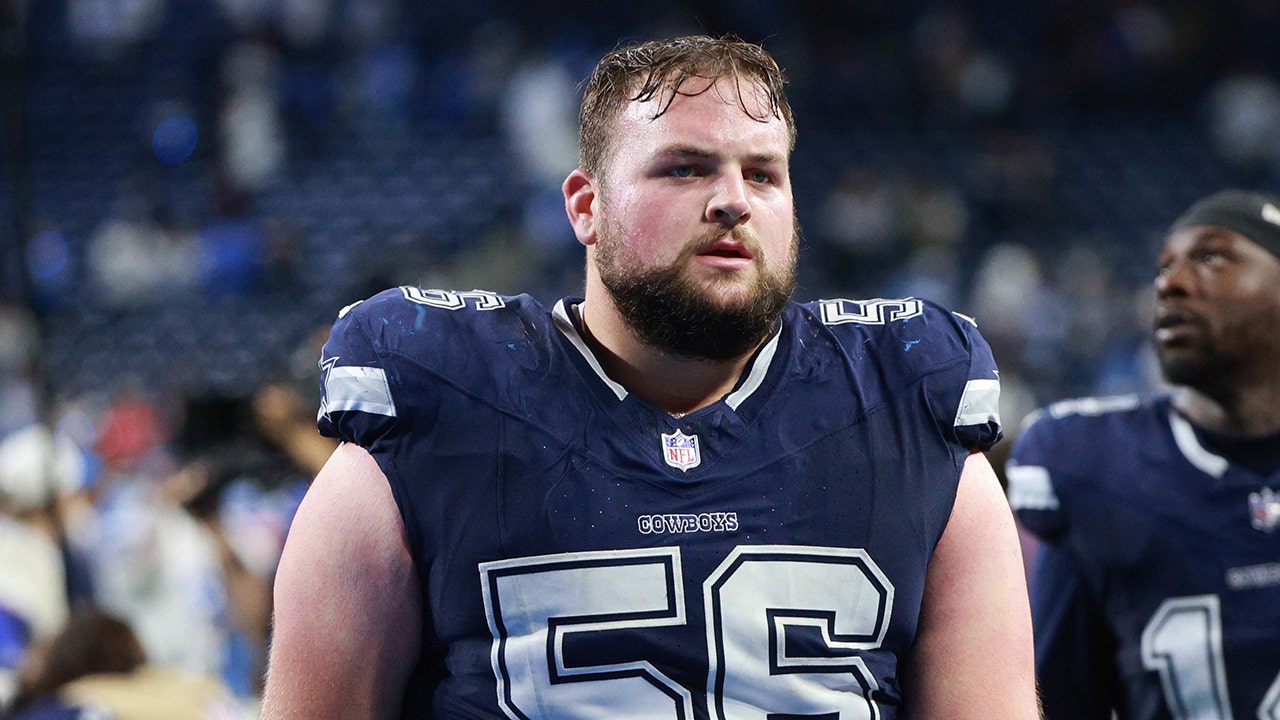
Cowboys center Cooper Beebe accuses Chargers of making him look racist in controversial post
In today’s technologically-driven society, the power of social media cannot be underestimated. It has become a platform for individuals to share their thoughts, feelings, and experiences with the entire world in just a few clicks. However, with this power comes great responsibility, as the potential for misinformation, manipulation, and deceit is always present. This was the case for Cowboys center Cooper Beebe, who found himself at the center of a social media storm after being accused of making racist remarks on the field.
The incident in question occurred during a game between the Dallas Cowboys and the Los Angeles Chargers. As Beebe lined up for a play, he could be heard on the field making what appeared to be a racist comment towards one of his opponents. The video of this moment quickly went viral on social media, leading to widespread backlash and condemnation of Beebe’s alleged behavior.
However, Beebe quickly came forward to defend himself, claiming that the video had been doctored and edited to make him appear in a negative light. He maintained that he had never made any racist remarks on the field and that he was being unfairly targeted by those who sought to discredit him. Beebe’s teammates and coaches also came to his defense, citing his character and integrity as evidence of his innocence.
The controversy surrounding Beebe’s alleged racist comments quickly spiraled out of control, with fans, commentators, and the media all weighing in on the situation. Some believed Beebe’s claims of innocence, citing the lack of concrete evidence to support the allegations against him. Others, however, were less convinced, pointing to the video as proof of his guilt.
As the debate raged on, the Los Angeles Chargers found themselves in the crosshairs of the controversy. Many questioned whether they had intentionally edited the video to incriminate Beebe and tarnish his reputation. The Chargers vehemently denied these accusations, stating that they had no involvement in the creation or dissemination of the video in question.
Despite the Chargers’ denials, the damage had already been done. Beebe’s reputation had been called into question, and he found himself at the center of a firestorm of criticism and condemnation. The accusations of racism, whether true or false, had taken on a life of their own, spreading like wildfire across social media and beyond.
In the midst of the chaos, Beebe made the decision to take legal action against the Chargers, accusing them of defamation and slander. He sought to clear his name and restore his reputation, which had been tarnished by the allegations of racism. The legal battle that followed was long and arduous, with both sides presenting their evidence and arguments in court.
As the case unfolded, new details emerged that shed light on the true nature of the incident. It was revealed that the video had indeed been edited, but not by the Chargers. Instead, it was discovered that a rogue fan had manipulated the footage to create the false impression of racist behavior on Beebe’s part. The fan, who was quickly identified and apprehended, confessed to his actions and issued a public apology to Beebe and the Chargers.
With this new information coming to light, the case against the Chargers crumbled, and Beebe’s innocence was confirmed. The fan responsible for the falsified video was held accountable for his actions, and Beebe was exonerated of all charges of racism. The media frenzy that had surrounded the incident began to die down, and Beebe was able to resume his career with the Cowboys without the stain of controversy hanging over his head.
In the end, the story of Cooper Beebe serves as a cautionary tale about the power and pitfalls of social media. It demonstrates the ease with which misinformation can be spread and reputations can be destroyed in the blink of an eye. It also highlights the importance of due diligence and critical thinking when consuming information online, as not everything is as it seems.
As for Beebe, he emerged from the ordeal stronger and more determined than ever. He used the experience as a learning opportunity, vowing to be more vigilant and proactive in protecting his reputation in the future. And while the scars of the incident may never fully heal, he remains steadfast in his commitment to proving his innocence and moving forward with his life and career.
In conclusion, the saga of Cooper Beebe and the Los Angeles Chargers serves as a reminder of the power of social media to both build up and tear down. It underscores the need for caution and discernment in the digital age, where a single tweet or video can have far-reaching consequences. And it serves as a testament to the resilience and determination of those who refuse to be defined by the actions of others. Beebe’s story is a powerful reminder that, in the face of adversity and adversity, the truth will always prevail.
Source: Fox News






















 LIVE
LIVE LIVE
LIVE